Webinar - Does It Work, Does It Translate, and Does It Help or Harm?
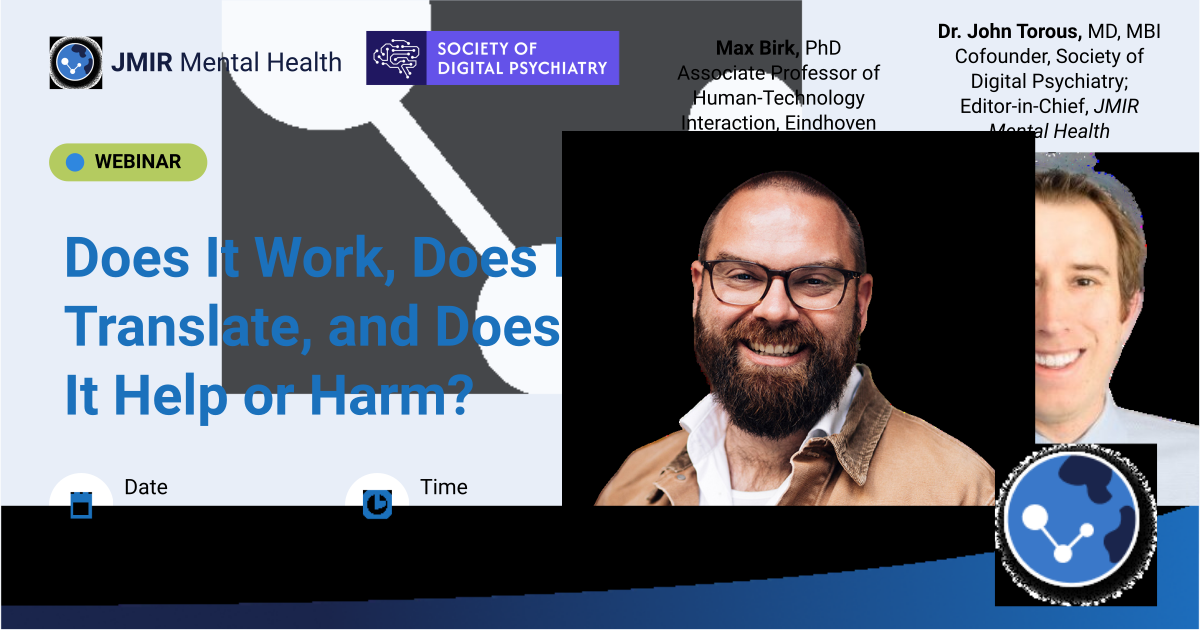
The Society of Digital Psychiatry, in collaboration with JMIR Mental Health, an open-access, peer-reviewed journal published by JMIR Publications, invites you to a webinar titled “Does It Work, Does It Translate, and Does It Help or Harm?”
Large language models (LLMs) and other AI tools are rapidly reshaping digital mental health—but are our research methods keeping pace?
Join Dr. Max Birk and Dr. John Torous as they explore how LLMs and AI tools are changing the evidence needed to guide the digital mental health space. Drawing directly from their recent JMIR Mental Health editorial, they will address the urgent need to move beyond simple feasibility studies, share how to build research that remains relevant as technologies evolve, clearly explain how specific AI tools work, and test them against meaningful comparators and controls.
An associated call for papers can be found here.
Key Takeaways
- Moving Beyond Feasibility: Traditional feasibility studies are no longer enough. Learn why AI in digital mental health demands rigorous evidence focused on clinical efficacy, translation, and long-term impact.
- Evaluating Safety and Harm: Discover practical frameworks to assess whether LLMs and AI tools genuinely support patient well-being or introduce subtle risks, biases, and unintended harms.
- Future-Proofing Research: Gain actionable strategies for designing adaptable research methodologies and selecting meaningful control groups that keep pace with rapid AI advancements.
The webinar will be held on October 27th, 2026 at 12.00 PM ET. To register, please use this link:
Speaker:
Max Birk, PhD
Max Birk is an Associate Professor of Human-Technology Interaction at Eindhoven University of Technology. He studies what interactions with digital technologies reveal about people, and how the design of those technologies influences psychological functioning, behaviour, and well-being. His interdisciplinary research combines psychology, human-computer interaction, data science, and game design, with particular emphasis on game-based digital biomarkers, stress and cognitive assessment, behavioural design, motivation, and player experience. His work develops computational and experimental methods for translating rich patterns of digital behaviour into interpretable measures of human functioning, while examining how interactive systems can be designed responsibly to support health and well-being.
Moderator:
John Torous, MD, MBI; Cofounder, Society of Digital Psychiatry
Dr Torous is the director of the Digital Psychiatry division in the Department of Psychiatry at Beth Israel Deaconess Medical Center, an affiliated teaching hospital of Harvard Medical School, where he also serves as a staff psychiatrist and member of the academic faculty. He has a background in electrical engineering and computer sciences; he earned his undergraduate degree from the University of California, Berkeley, before pursuing medical school at the University of California, San Diego. Dr Torous completed his psychiatry residency, fellowship in clinical informatics, and master’s degree in biomedical informatics at Harvard. He actively investigates the potential of mobile mental health technologies for psychiatry and has published over 200 peer-reviewed articles and 5 book chapters on the subject. Dr Torous serves as the editor-in-chief of JMIR Mental Health.